Jared left straight after breakfast and I went back to bed. Check out was at 10 and, today being a rest day, I still had a good hour of lounging before they kicked me out.
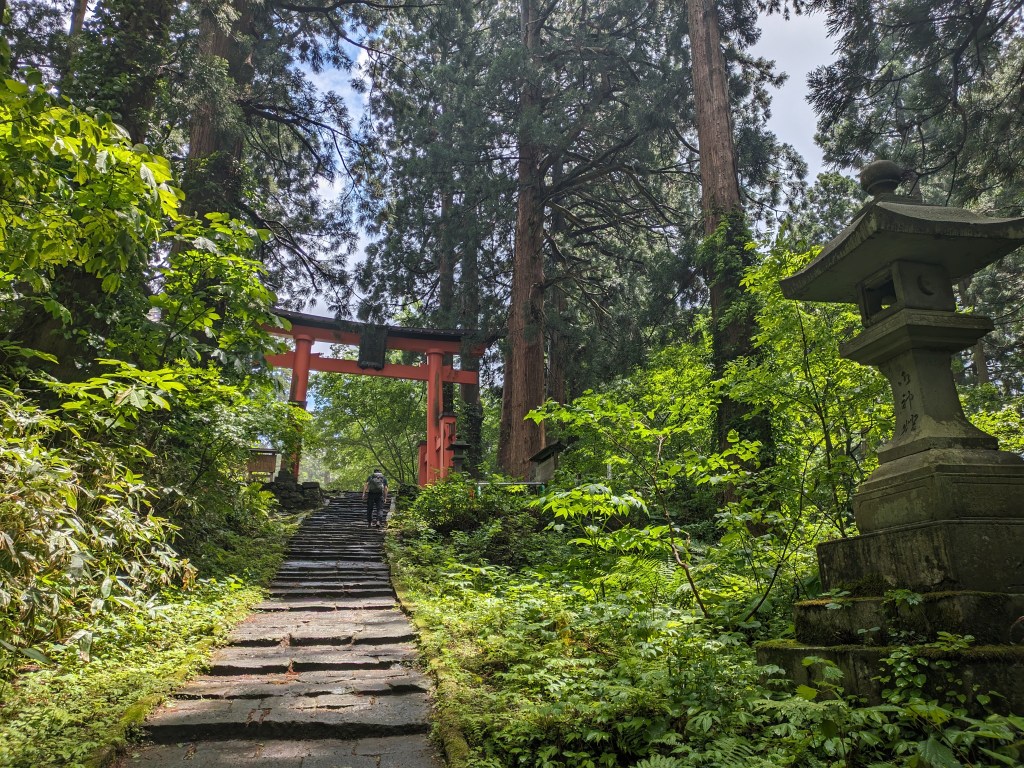
As I mentioned in another post, Mount Haguro is dedicated to the Shugendo, an esoteric mix of Buddhism and Shintoism in which believers undertake austerities – pilgrimages, fasting, praying under waterfalls etc. – as a fast track to enlightenment. I was so fascinated by this idea at university that I wrote my dissertation on it and I was curious to see what traces of it remained. So I set off at ten to climb the 2,000 odd steps to the summit and visit the temple complex.
You get to the steps through the Zuishinmon gate, a low key tori with rocks on either side. When I arrived around 40 quite elderly people, maybe from a walking club, were performing a warm up routine outside it as a prelude to walking up. It was easy to mock, but they did deep knee bends in unison and I don’t know many people in Europe who can still do that.
The steps themselves are made for people with size 7 shoes or smaller. They are cut from rock and are different in size, stones and, some grooved, all slick with rain. They wind past small boxy shrines each dedicated to a different god, past a waterfall, tea rooms and the Five Story Pagoda, which was sheathed in scaffolding. Old pine and cedar trees tower over it all, and there was the inevitable bear sighting sign which I couldn’t be bothered to read.
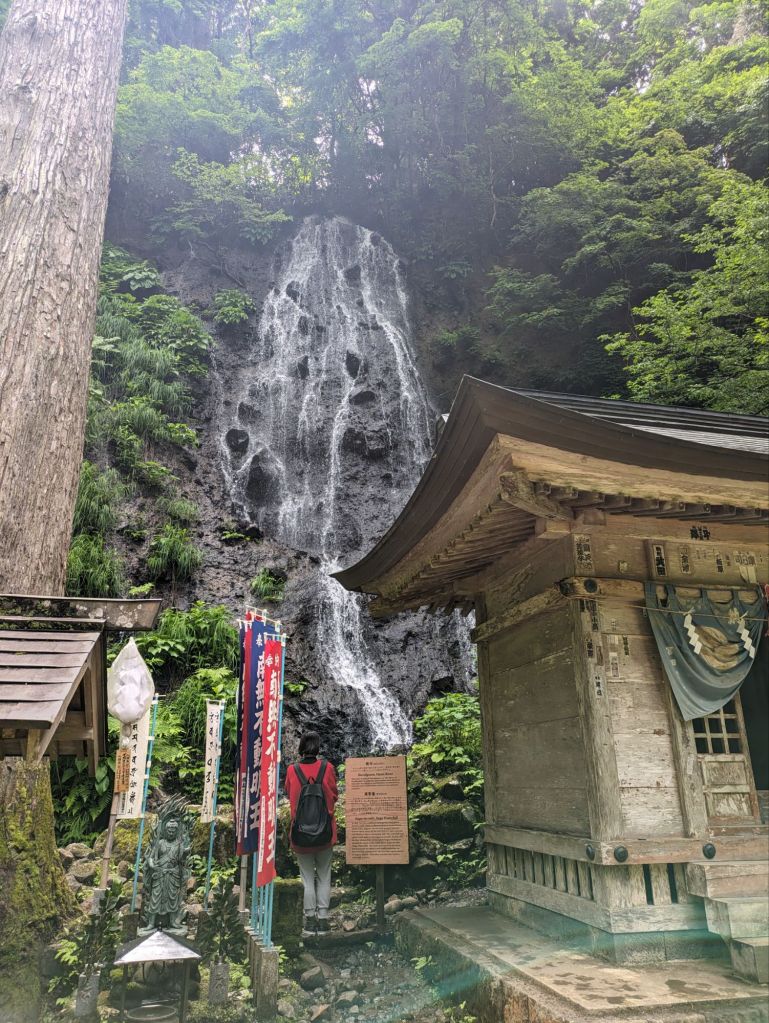
I took most of the stairs two at a time, stopping where there was something to see, such as an unexpected monument to Basho. At the very top I passed under a red tori (see cover) to where some elementary school children were playing.
Some Yamabushi, the ascetic monks of Shugendo, appeared from a doorway and marched in a line to the main shrine where they stood and chanted. They were dressed in white, the colour of the dead, and were wearing their distinctive white head gear. They were all men in their later years and, while they chanted in harmony, their shoulders were round and their bearing unimpressive.
I had seen the real deal once before on Mount Yoshino, a real mountain priest who stepped lithely out of the forest, his clothes travel worn and his eyes focused on something I could not see. He’d stopped at a small statue, prayed, made a mysterious hand gesture, walked on. These men, in their pristine outfits and well practiced rituals, were as far as I could tell, were merely going through the motions.
Maybe I’m wrong. Maybe I got to see the for-tourist show and the real stuff is done off stage. Or, could it be that the religion has just ossified into whatever best suits the status quo, existing just to ensure its continued existence?
I wandered around the grounds and found an engraved plaque set into a rock that further deepened my fug. I’ll write the whole thing out sometime and merely paraphrase it here:
Hello. I don’t wish to boast, but my family’s been lording over this region for 2,500 years and, thanks to us, we live in a multicultural society. We also make all the best Yamabushi. Here’s a stupid rock with my name on it.
Or words to that effect.
I picked my way down the steps. Many people said hello and I enjoyed a few brief chats. Despite it being a rest day, I cycled out of town for lunch and passed a group of elementary school kids walking home. They write bear bells.
I’m the only guest in a ryokan that could easily fit fifty. They hadn’t run the bath for the single foreigner. All the facilities are on a large scale, and my room looks into the car park.
I shouldn’t have planned to rest here. It feels lonely for the first time after a week of company. I should have ridden somewhere to spare myself the silence.
Jared made it back to Aomori and dropped the car. He’s out with friends so I can’t text him.



 The Himedomachi Cycling Club
Leave a comment