
I really struggled to get out of bed this morning. The problem of staying somewhere comfy. I managed to move by 7am and was outside setting up Ribena by 8am, forgetting that I had set my alarm. I fear the picky man was woken up by electronic funk blasting through the fusama. I don’t suppose it improved his miserable mood.
My mood was improved by finding the old walking trail up to Eiheiji Temple, now a cycling path with benches and markers showing the distance in miles. It was exactly four to the temple and I wish it had been more.

It takes a zen garden several centuries, but nowhere I’ve visited grows moss quite like it. Moss on the stones and the bridges and the statues. Moss growing up the roots of centuries old pine trees. Moss on the bridges.

I left Ribena to contemplate the Four Noble Truths and went to the loo, startling a Japanese biker so much he fell over an ashtray. There is a sign asking you to wash your hands before you enter the temple and dragon head taps that spring magically to life as you approach them. Inside a bank of Zen monks were working the phones in their black robes and face masks. I paid the entrance fee – no Zen without Yen – and walked inside, picking some kind of creepy crawly off my neck and dropping it on the floor where it flipped into its many feet and asked me what Dogen would think of my behaviour.
I regretted coming inside. I loved the millennium of care that had gone into the gardens and the symmetry of the buildings, and by contrast the inside seemed quite institutional with its bought from an office shop fittings and functional handrail. However, the further I went in the more I admired it. Eiheiji is a living temple with monks and acolytes walking its many halls. Acolytes were polishing the step into their main practice halls and others rushed about it brooms. The smell of something nice came from the kitchen
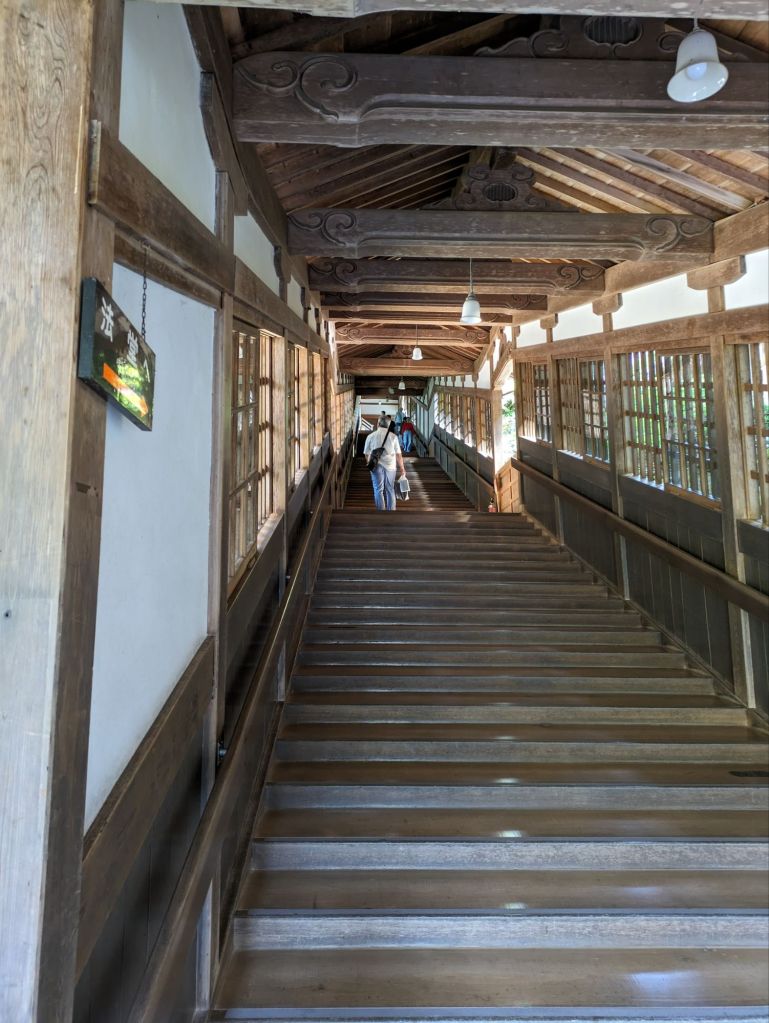
You could visit almost anywhere in its seven buildings. While there was some flashy gold trim in places, on the whole it seemed to reflect Dogen’s belief in constant practice, his steadfast concentration on the present, and I quite admired that. There was no feeling of us and them either, which has been my recent experience in the Catholic church. Everyone was welcome, even foreign cyclists.
Visitors have to take their shoes off to get in and carry them around in a plastic bag (the monks patter around in white, thonged slippers.) So, other than the sound of crinkly plastic, there is a hush. Drawn by the sound of chanting, I watched the Abbot, I suppose, and some monks chant sutras to the chime of a bell.
I wish I’d stayed longer in Eiheiji. I loved the lodging house and I would have lingered at the temple, even come back to sit zazen, but I had another 95 kilometres to ride and it was already 10am.
I cycled over the pass and onto the Fukui plains. The temperature was a perfect 18 degrees and I had the road almost to myself.
I had been hesitating over which road to take to the coast. I had plotted a course on the 19 as the tunnel seemed more cycling friendly. Booth had taken the shorter 8 and had almost been squashed by lorries in the tunnel. I checked Google Maps again and the tunnel in the 8 didn’t seem so bad – I could walk through it. Possibly in Booth’s day there was just one, two-way tunnel. Now there are two tunnels, each with two lanes. The pavement was narrow, the walls filthy, the floor muddy, but I squeezed through it. The only time I was in any danger was when a, “Drive Safely” blocked half the pavement and I had to hop onto the road to get past.
I descended towards Tsuruga, through a succession of shorter tunnels. I sped through those, pushing my speed to just above the national speed limit, or approximately half the speed of the car drivers. The road narrowed as it reached the sea and I was happy to get off it.

I got talking to an ultra cyclist and two of his friends at a convenience store. He had completed the Paris-Brest-Paris race, a 1,200 kilometre epic, the previous year and was in the middle of a race when I chatted to him. I mentioned my trip across Japan and he didn’t bat an eyelid. I’m not sure who’s crazier, me or him.
“How do you get through the long tunnel at the top of the pass?” I asked him.
“I cycle through,” he said. “My pace.”
In reflection, I think it’s him.
I picked up a cycle road in Tsuruga that took me almost directly to the ryokan in Mihama where I’m staying. I waved and gave the thumbs up to the other competitors who were trailing miles behind my new cycling friend.
I’m lying in a yukata having eaten my weight in greasy food. My body still feels good, maybe something to do with the nightly hit bath ritual. The woman who runs this place must be from Atsumionsen as it was almost unbearably hot.
I’m spending most of tomorrow on a cycling route. Alan Booth said the people of Fukui were blunt. I haven’t found that. In fact, I’d like to come back here someday and take it slower, explore the many sights I didn’t see, and breathe in the atmosphere. I’d been looking forward to Eiheiji and I’m sorry to see it go. I’ll be in Kyoto prefecture by tomorrow evening and a couple of days later Hiroshima. The south is beckoning me. I’m loving these journey but I’m dying to be in Kyushu.



 The Himedomachi Cycling Club
Leave a comment