Over the enormous breakfast the ryokan owner brought me I mentioned that I was in the trail of Alan Booth and speculated that he must have stayed here.
“Fifty years ago? I don’t think so. Unless he just slept. There was no evening meal then.”
She told me that most of the places had closed and just them and another place were open now. Indeed, it was a massive stroke of luck She and her husband were here at all. They had had other plans. She asked me which way I was planning to go and when I told her she suggested the route by the sea.
“You’ll have to bring food as there are no shops, but it’s much more beautiful than your road.”
I’d read a post from another cyclist who had raved about it and, still unsure if I could navigate, decided to take it as it was a straight shot down to Teshio.
I cycled away from Soya with a kind of sorrow, I’ll never come with way again, and went back to Wakkanai.
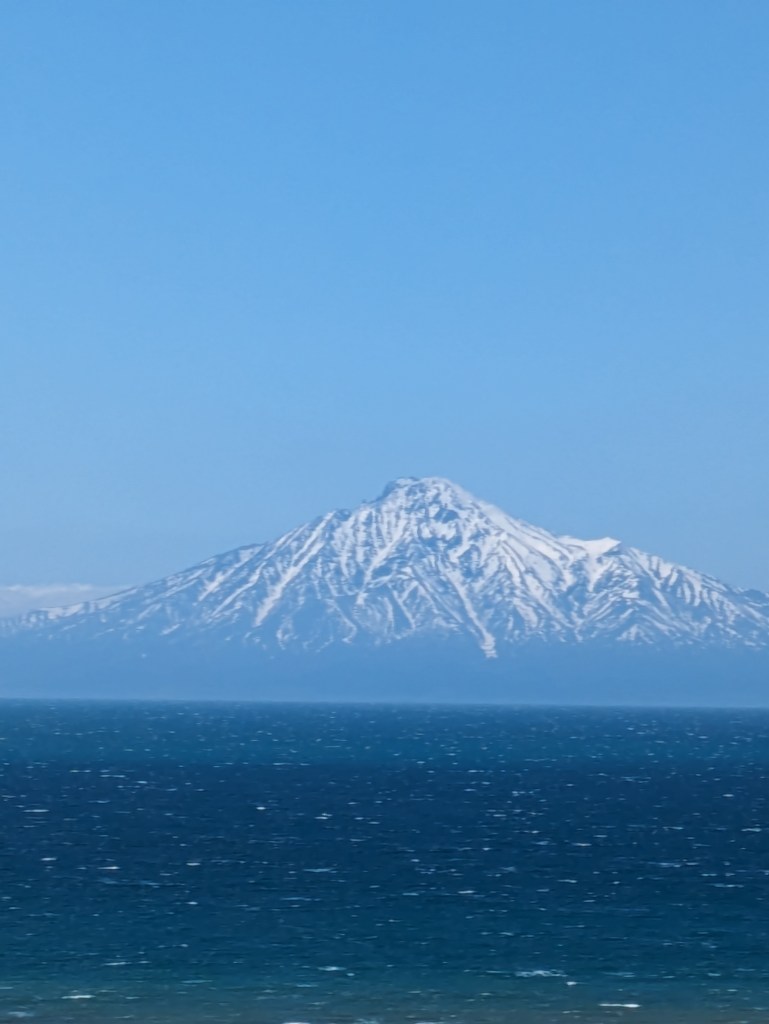
As I climbed the hill out the town three deer nonchalantly crossed the road. At the crest, Mount Rishi in the above photo came into view. It’s easy to see why the Japanese worship their mountains.
I hit the wind on the descent and, even though I wasn’t braking, I hardly picked up any speed. And that was essentially how I spent my day, sometimes going full gas on the pedals and going nowhere.
It was along this road that the Japanese depopulation crisis struck home. I passed an empty primary school with half the road missing. Houses lay abandoned on the outskirts of town, rusted, ruined, in many cases collapsed entirely under the weight of their roofs. I wouldn’t see a lived in house for 50 kilometres after Bakkai
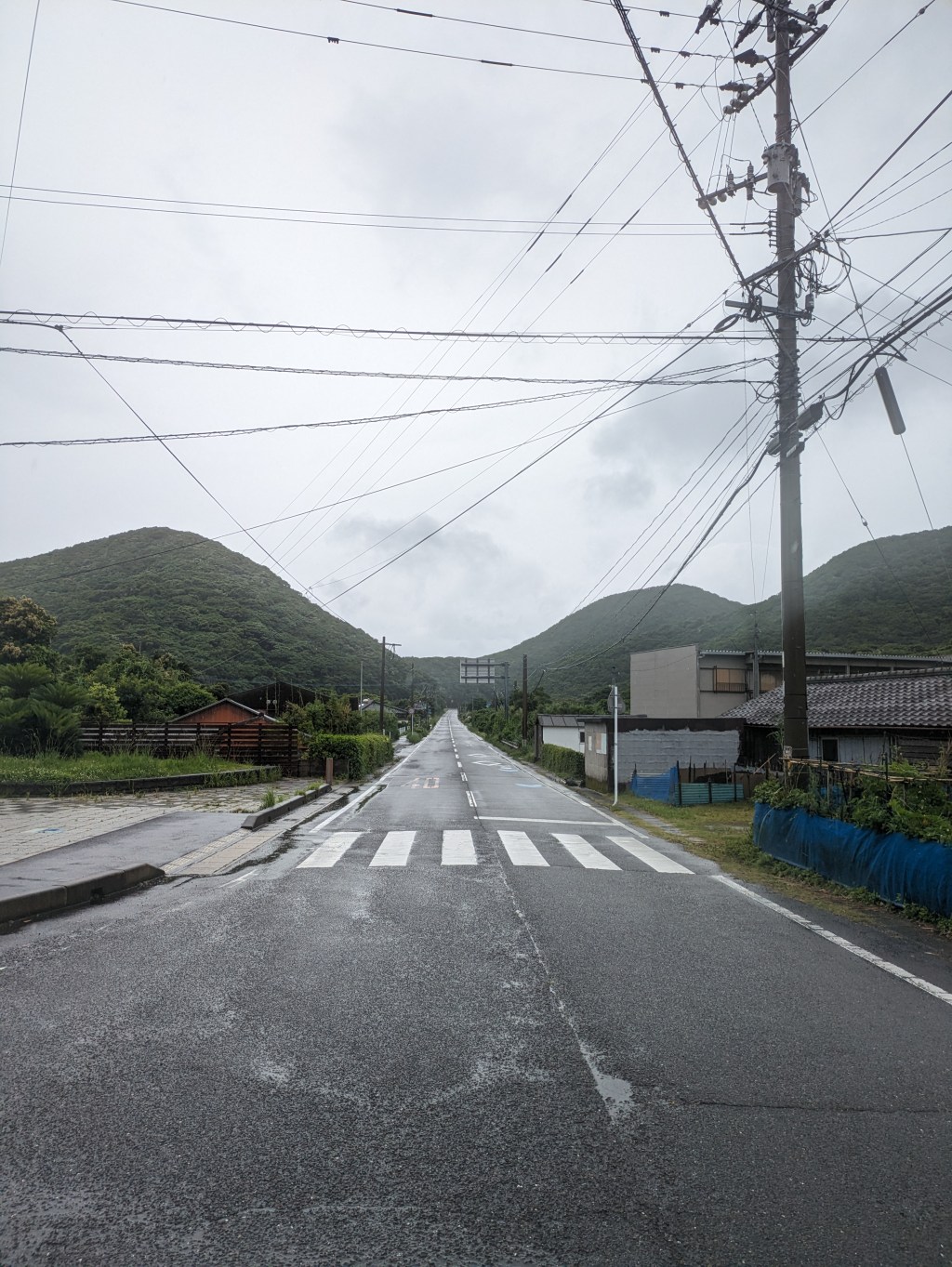
The road was so straight it ended in a mirage and the wind screamed down it. I was struggling, the wind farms were doing excellent business. A man in an enormous cherry picker had been hoisted into the air and was fixing a sail as I passed. The portacabin offices were lashed to the ground with chains.
I passed rubbish dumps where diggers and caterpillars stood on huge piles of dirt shovelling earth from one place to another. Streams of trucks bought more work for them, coming up the road full and passing me empty. So many of them that they had ploughed grooves that perfectly fitted their tyres.
I approached a tunnel that had been built to shelter in during winter emergencies. A truck came up behind me, the noise echoing off the tunnel walls so loudly that I dipped into a lay by and pulled in my brakes, certain it was going to squash me. In fact, it had pulled into the other lane to give me space, it was just loud.

I passed a bear warning sign. These are bright yellow. Half is dedicated to a drawing of a roaring grizzly, the other shows the date it was seen. In this case, more than three weeks ago. I don’t see the point of these signs. It hasn’t escaped my attention even for a minute that I’m in bear country. The spray I was carrying would be quite useless. Unless I could get up wind of the animal in the half second it gave me the chances were the wind would blow it back in my face. Then I would be facing a bear completely blind.
I cycled on growing more tired and more tired until I reached the top of a hill almost crying in frustration at how hard it was to cycle. Then, Obi Wan Kanobi like, the words of Mark Beaumont came back to me. He contends that 90% of the cyclists mood is dictated by his food, so I stopped and ate sweets and an energy bar, drank some water and felt a bit better.
I was looking forward to getting to Wakasanai, a town just 25kms short of Teshio. It turned out to be a collection of abandoned buildings and a public convenience in a parking lot. I propped my bike up against the toilet building and for the first time in several hours stepped out of the sun and the screaming wind. I drank, refilled my water bottles and told myself I was almost there.

I missed the two towns Booth passed through, Horonobe and Toyotomi. I had passed through them on the train from Sapporo and, frankly, they both looked like ruins. They store nuclear waste near Horonobe, but, more positively, the single Bambi in The Roads to Sata, has had many many children and become an entire deer park with a restaurant.
I arrived in Teshio 8 hours after I set out, averaging just 14 kmh over 100kms (slightly more than 12 if you count rest stops). As a reference, this is my average speed on my mountain climbing days, except today there was no downhill to relax and recover on. I have cycled 200 kilometres in a day in the past and I would say this was easily comparable.
I stayed the night in an onsen (hot spring) hotel. They had a row of gleaming high-end Pinarello and Bianchi road bikes for hire and a safe area I could store my bike. It had free fizzy drinks and a coin laundry and after supper I changed into the hotel’s baggy trousers and jacket and took a bath. There were three to choose from, all pretty big, and I chose one where two men were already relaxing.
When they saw me one of the men made the ‘Eh?’ sound to his friend, meaning, ‘Watch out, there’s a foreigner.’ I gave him a stare and a cold nod. There was enough space for twenty, but nonetheless they both got out. 25 years ago this would have upset me, now I just found it pitiable. If they had stuck around we could have had a nice international moment together, me, him and his ignorant mate.
Needless to say, I went to bed utterly exhausted. Tomorrow the Japan Met Office is forecasting gale force winds. If there worst comes to the worst I’ll take the bus.
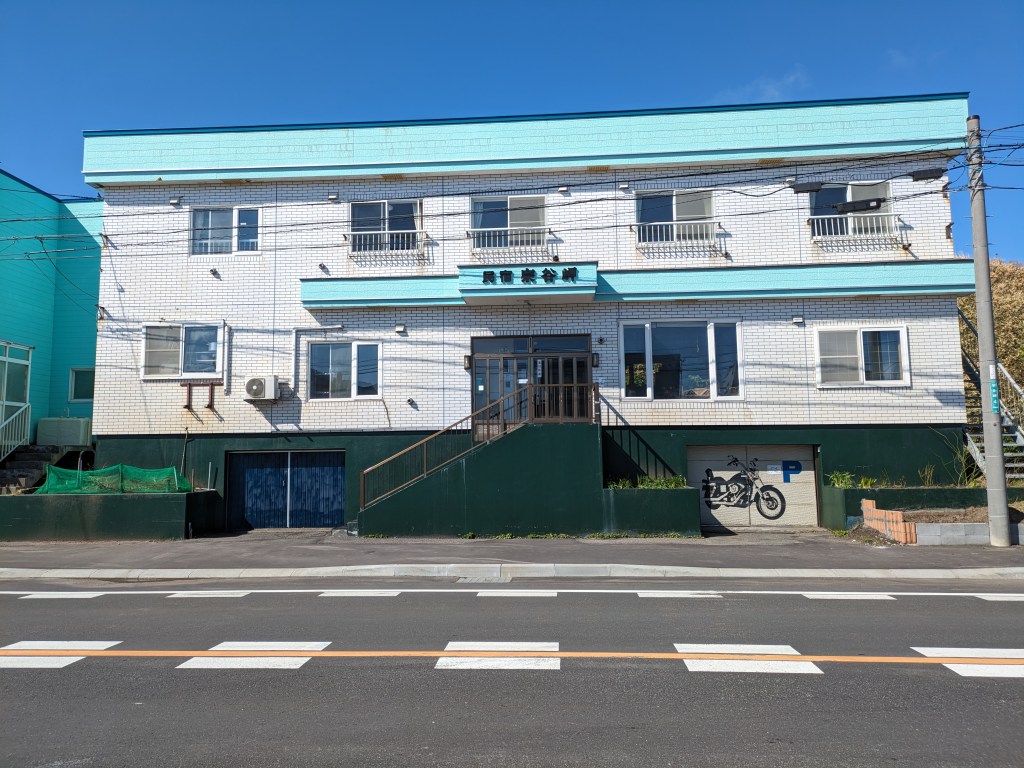
(The ryokan in Soya)



 The Himedomachi Cycling Club
Leave a reply to chrisinthailandc8eb48619e Cancel reply