
“Everyday is a good day.” There are no bad days. Even bad experiences are good. Motivational words from Jules via a Buddhist monk.
The night before last my host at the ryokan told me she had the Board of Education in for a party the next night. I’ve been to those parties. Drunkenness and nudity. She rolled her eyes. Her husband and son spent the evening in front of the telly. She spent it in the kitchen. When I went down in the morning her son, who has Down’s Syndrome, was running the water in the bathroom. I understand this is very calming. I wished him a good morning but he didn’t reply.
I think about Mr Ohno who ran the Koizumi hotel in Toya. Last week’s guest list was still pinned to the door and all the names but one were non-Japanese. A love hotel stood derelict up the road and his hotel was surrounded by abandoned buildings. In Haguro the number of old ‘Oka’ – the ryokans run by lay members of the Shugendo sect – had shrunk to about a quarter of their original number. In the Tamonkan where I stayed, five guests were foreign and there was only one Japanese person. It strikes me that only the places that allow foreigners are staying open.
When I lived in Japan half my life ago it was impossible to get a room if you were foreign. The chances of a foreigner mucking slipper etiquette up, or not liking fish, or just being weird were far too high. I remember calling a ryokan to make a reservation and listening to a discussion between the owners on whether they could let a Chinese person stay. I guess many of those places are sitting empty by the side of the road now and the children have decamped to Tokyo, Osaka or another one of the mega cities where 75%+ of the population lives. Booking.com might commodify the process but must play a role in keeping those places open.
When I lived in Japan I frequently came across the Nihon Ichi Ban types. “Japan Number One!” they’d shout at me, giving me the thumbs up to add emphasis. I haven’t experienced this yet. People seem pretty humble about Japan’s place in the world. Going out on a limb slightly, I imagine it’s pretty humiliating to rely on Asian countries traditionally viewed as inferior to buy up the moribund yen and keep at least the tourist industry afloat.
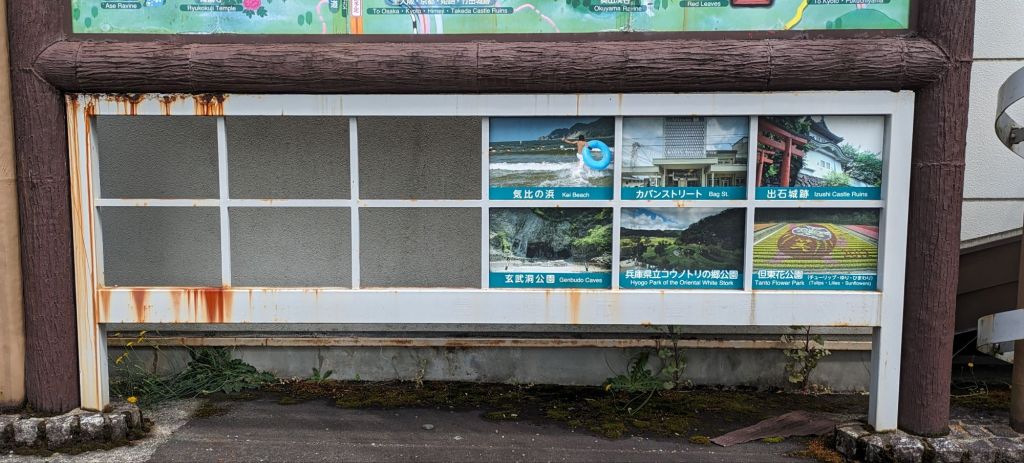
I’m currently sitting outside Tooyoka Station. The information panel for the local tourist attractions is rusted and six panels are missing. Tourist Information is closed. The majority of tourists I’ve seen come by tour bus now. From what I’ve experienced, the young Japanese go abroad. I don’t have the relevant statistics to hand, but I’ll fill out this blog later when I’m not tapping it into a phone.
The place I stayed last night was vast and empty. A reviewer on Airbnb called it spooky and I’d agree. Stairs led up to the second floor and, as I sat in the living room, it sounded like someone was stepping onto the top step over and over again, which really lent the experience a certain je ne sais pas. It was just the wind. If someone dies in a house most Japanese people won’t buy it so they tend to go very cheaply. I tried to ignore this little factoid as shutters banged. Free biscuits though.

I’m heading to Ohara today. My schedule called for 140km of cycling with 2,500 metres of ascent. Which is to say, it’s in the middle of nowhere. The woman at the Bates Motel asked me to point it out on her wall map, which only listed the major cities. I found the largest empty space in the middle of Hyogo Prefecture and put my finger there.
I’m disappointed that I’m on the train again. I’ll tot up the cycling vs. train vs. bus miles later. I knew I’d take the train through the Noto earthquake area, but I didn’t expect to take the train today, and the bus/Jared’s car in other occasions. However, if I had cycled today it would have taken me 12-14 hours. I made such a large leap because I really wanted to spend two nights in Ohara. Experience has shown me that I can just about do 110k in a day. 140 is completely beyond me. Booth called his style the Protestant walk ethic. I call mine the Catholic cycling credo.
Ohara is special as it’s the hometown of Miyamoto Musashi, Japan’s most famous swordsman, who invented the two sword, ‘Ni Ten,’ school and wrote The Book of Five Rings, his treatise on life and swordsmanship. He wrote the book in a cave in Kumamoto, where he died. I’ve visited the cave and other places of significance in his life, Himeji Castle and a pine tree in Kyoto. Although my Musashi phase has passed, I’m keen to finish off my 25-year sightseeing tour with his birthplace.
Musashi wasn’t just a fighter, he played the taiko drums and was a brilliant calligrapher and painter too. An extremist in everything he did. His book has fallen out of fashion, but I still it occasionally to impressionable young men and the odd business type.
I’ve reflected a little bit on why yesterday was such a bad day. I didn’t fill up on carbohydrates the night before, preferring to riffle through the discount bins. I didn’t speak to anyone during the day. Other little things. As a friend pointed out, the events mastered me, rather than the other way around.
I’ll think about this and move on. There are no bad experiences. Failure is part of trying to do great things. Mentality is everything.



 The Himedomachi Cycling Club
Leave a reply to The Himedo Machi Cycling Club – The Himedomachi Cycling Club Cancel reply