
I left the Nimi Business Hotel with few regrets. Business in the sense that it was run as a business and everything had a charge. A squirt of liquid for the washing machine cost 200 yen. The people at the front desk watched me closely when I took a free toothbrush in case I overstepped my allocation.
School children cycled to school in ones, twos and threes. It was like the old computer game Astroids where you had to pilot a spaceship through an asteroid field and lost a life if you collided with one. Except Ribena is not equipped with lasers and the school kids came at me from all angles.
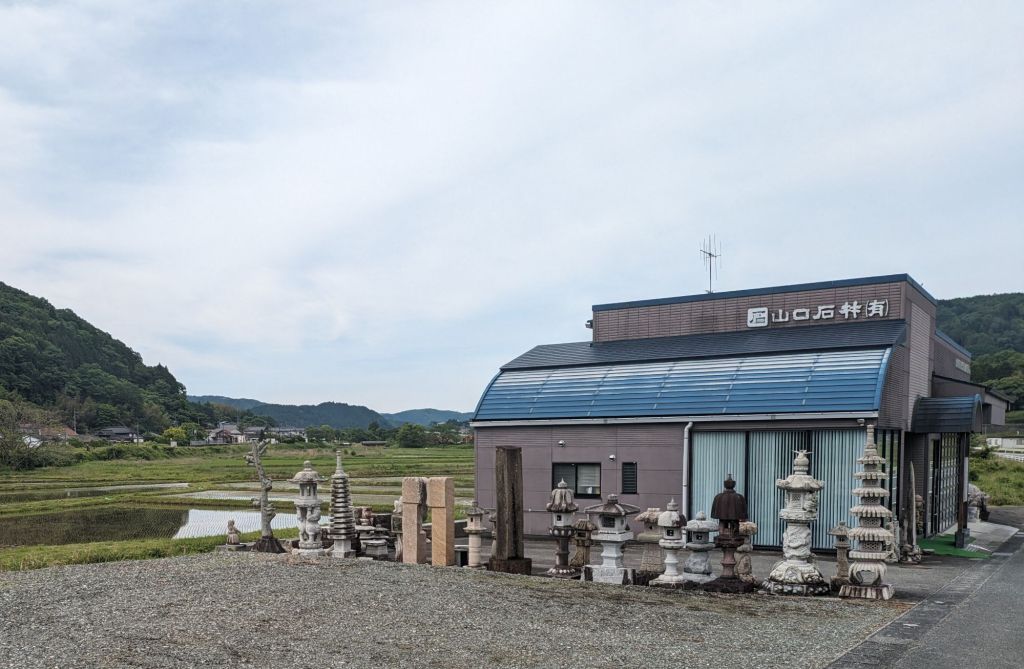
The motorway siphoned off a lot of the traffic and I had the 183 all to myself as I cycled up the pass, through the tunnel and down the other side. I passed a stone mason specialising in headstones and garden ornaments. Headstones must be a growth business as these shops are really common. There was one in Tsuyama called Memory Land.
I had a decision to make in Tojo. I could cut through the mountains, which would be shorter but utterly deserted. Or I could take the longer route, hopefully skirting the mountains and pass through several villages, including the intriguingly named Bingo Ochiai. I decided to visit Bingo. It would add 10 kilometres to my journey but there would be chances to rest and refuel. I had checked the map hastily, not realising there was a category 2, 13k climb. Oh, well. If anything, the mountain route looked steeper.
I stopped at an A-Coop, a kind of supermarket in rural areas run by local people. Dervla Murphy – the Irish writer who cycled to India solo in the 60’s – wrote that everyone trusts someone on a bike because it gives you a reason for being there. Sitting outside the A-Coop people who otherwise might have walked past me stopped to pass the time of day, always starting the conversation with, “Ah, you’re cycling.” I could have sat there all day with a sports drink and an onigiri. The last woman I spoke to said, “You’re almost at the top. It’s downhill all the way to Miyoshi,” giving me the motivation to get going again.
I missed Bingo-Ochiai – it was on the descent and I didn’t feel like stopping – but was delighted to find its sister town of Bingo-Saijo where the ground leveled out.
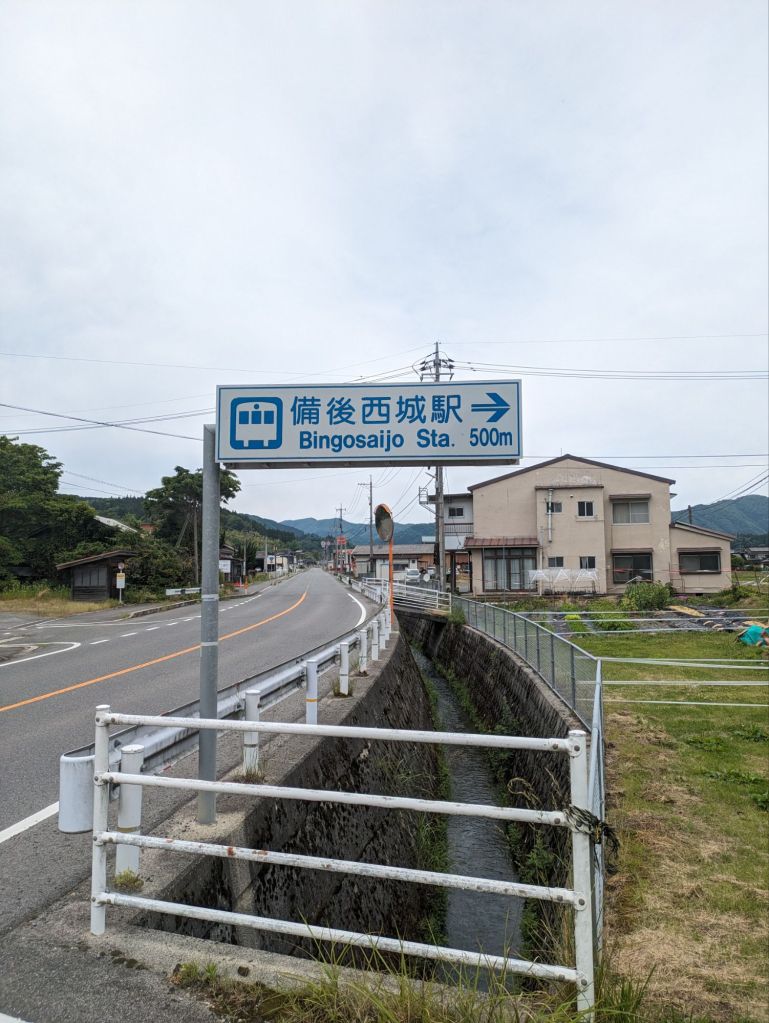
All these towns have a station, a post office and a police box. The post master was outside the office in one of the places I passed through watering a multitude of flowers that he’d arranged in pots and hanging baskets. The town couldn’t have had more than 500 people so I suppose that is what he did to fill the time before retirement.
I got lost in Miyoshi looking for the 183, going up and down the same side road and not seeing it, until I realised it was on a bridge over my head.
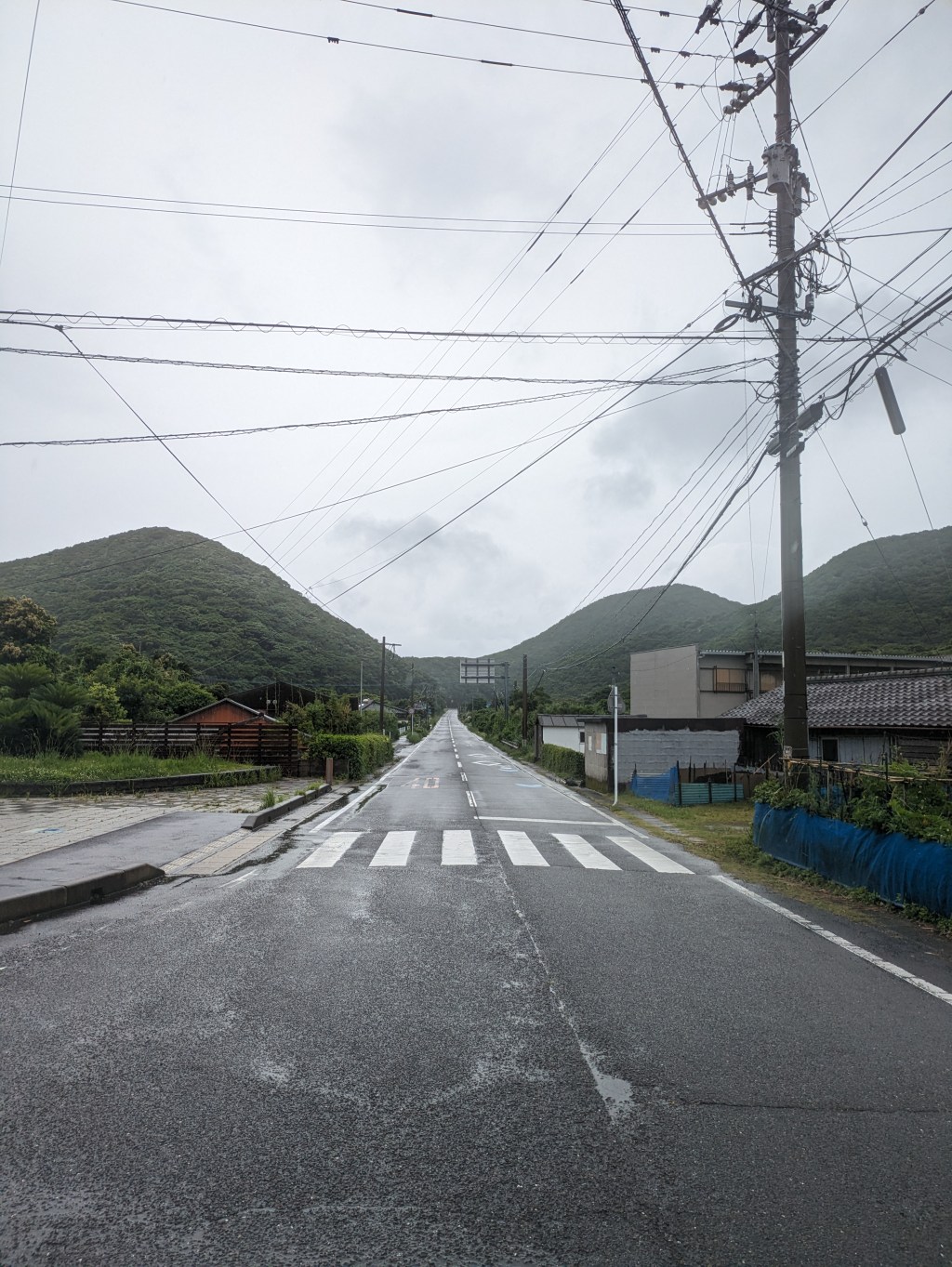
The roads were straight with short and sharp ascents and descents. I could watch a car go over the brow of a hill, disappear and then rise again over and over. I passed an amusement park with a giant windmill and slides painted in gaudy colours where a recording of brass band music blasted across the road. The effect was eerie, as if the designers had taken their cues from Squid Games or a facility they had visited once in North Korea. It was empty.
I cycled 104 kilometres, finally turning off the 183 into the hamlet of Kami-Kawatachi. My Airbnb host had suggested we have a drink after supper with his friend Naoki, so I arrived with pot noodles and beer from the nearest convenience store 8kms away.
Toki is half-Japanese and half-American, a tall, thin, good looking guy in his early thirties. He had moved from the city into the countryside and bought a house with an attached akiya. He had encouraged young people from the city to convert the akiya in return for food and lodging and a hands-on experience in working together. There was a wood stove for heating the bath, a kind of compost toilet requiring an accuracy I was pretty sure I didn’t possess, and a covered outdoor sitting area with a view onto his rice field. A pure white stork waded through the water, and as the sun went down the frogs began to sing
Toki and Naoki came back when the sun had set and we sat around the table, opening beers and chatting. We swapped stories of getting in trouble with the police. Toki had hitched across America and the police constantly warned him it was too dangerous. A friend of Naoki’s had travelled across Japan pushing a wooden handcart and had been stopped when he had ventured into the motorway. It made my story feel a little tame.
Toki makes a living as a singer songwriter, and has travelled to all 47 prefectures busking on the streets. In Aomori in winter people walked straight past in the snow and freezing wind. Too cold to stop and listen maybe but they still dropped money in his hat. Naoki played the video from Aomori and I found it deeply moving, understanding in that moment, perhaps, the loneliness and fierce independence of the solitary traveller.
Toki was homeschooled – hippy parents – and as well as music, he speaks to groups who are interested in the idea. 6,000 kids per prefecture are being homeschooled and the number is growing in reaction to the conservative nature of the Japanese education system.
I spoke to Naoki. He had done a variety of jobs, including making the sake we had moved on to (one of the reasons I’m two days behind on this blog.) He played the marketing video for the sake, all pure white rice, white clothed master sake makers wielding wooden rakes, and a voice over saying it was traditional Japanese culture etc. etc. Naoki explained they worked from the August rice harvest to the following March, without any holidays in conditions so hot they didn’t wear clothes. All this is in ironic counterpoint to the impeccably clean hands in the video, sieving rice into a bamboo container.
He was also an ultra athlete and had done three ultra races of 120k cycle, 3.5 k swim and a marathon to finish. It somehow didn’t surprise me that he had an iron core, despite his friendliness and generosity.
I fell asleep early with the feeling of being in the company of friends. I had drunk two thirds of a can of beer and about five cups of sake. Alan Booth would have been ashamed.



 The Himedomachi Cycling Club
Leave a reply to The Himedo Machi Cycling Club – The Himedomachi Cycling Club Cancel reply