
After finishing the blog last night a moth landed on the fly screen. I watched a small lizard climb stealthily towards it and swallow it whole, its tongue so fast I didn’t see it.
I headed out of town, already resolved to avoid the main road with its articulated lorries, narrow lanes and curly bridges, and instead detour through the forest where I knew there would be no one. The day was overcast but warm and I wore short sleeves and shorts.
My road rose through a series of hairpins and my legs told me they were not up for this. We had barely climbed 100 metres and they were feeling the fatigue was the last 500 kilometres. Even Ribena was sluggish. She’d prefer to read a book than climb a mountain. I hoped they would both wake up before too long.
An excavator with a strange attachment at the end of its crane picked up a tree truck, sawed it in half, then moved the trunk up and down stripping off its bark and branches. I thought, that’s exactly what I need for my kitchen.
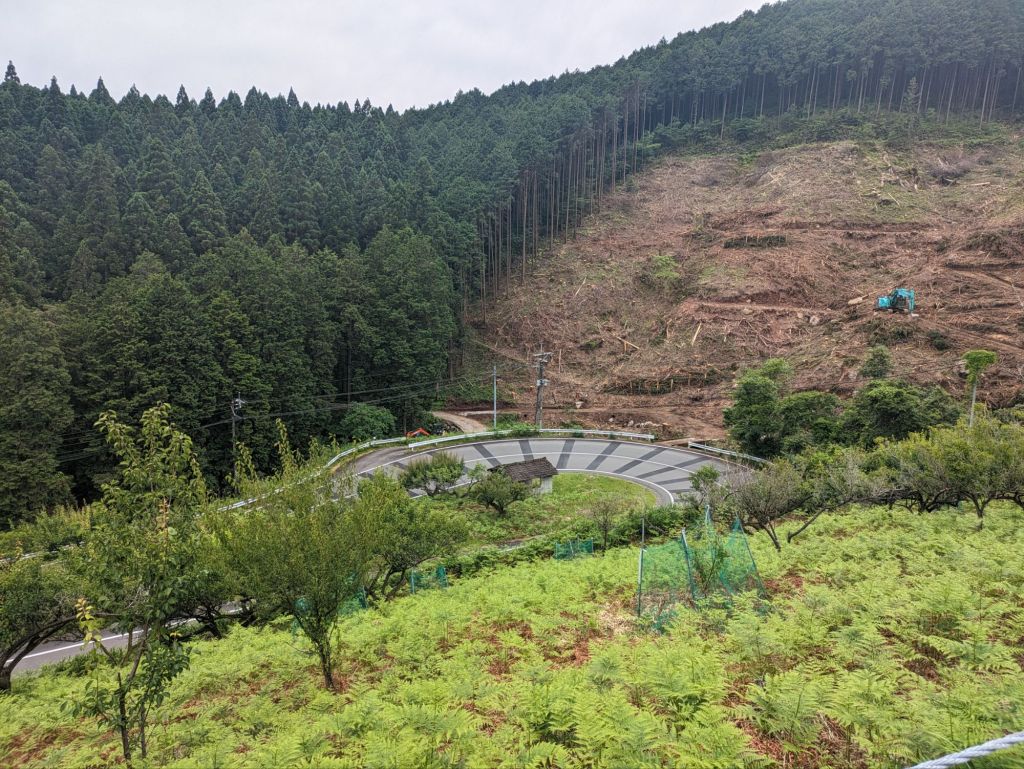
The road climbed steadily and after 10 kilometres my legs joined the party. The trees overhung the road on both sides turning the day into dusk. At the top of a climb two farmers chatted on the hard shoulder, in front of fields lined with electric fences. Dogs barked from the forest and a mountain dog jumped out of the woods without seeing me, crossed the road, turned and gave me the same quizzical the farmers had.
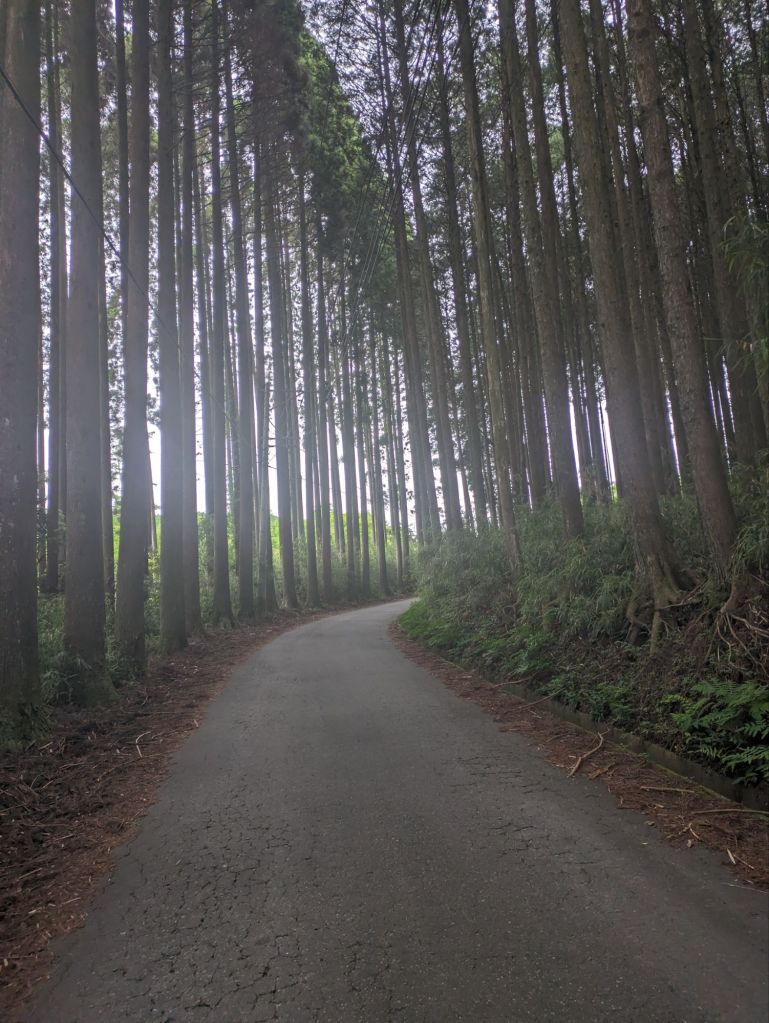
Rounding a bend further on, I heard a strange noise, in retrospect a kind of a barking sound, coming from the kerb. A mother tanuki and her kit. A tanuki looks like a brown and white badger and is a feature of Japanese folklore, statuary and art. I’ve passed many of them as road kill. This was the first time I’d ever seen them alive. The mother rushed at me, no doubt to protect her baby. I touched my stirrups to Ribena and she bolted forward, but the tanuki chased us twenty metres down the road. I have no idea what would have happened if she’d got her teeth into Ribena’s back wheel. Fortunately we were too fast for her.
We followed a ghost railway line to Yutake. I hope one day the Japanese will label these stations in the same way they signpost their castles. The Ruins of Yutake Station 30m. Or maybe a talented photographer will come to this region and turn them into landmarks.
I was snacking above the station when a woman walked up the road and greeted me in polite Japanese. It’s so hard to guess the age of Japanese people. I’d say in her sixties but she might have been a decade older. After answering the normal questions about myself, I asked her if she was from Yutake. She pointed down the road to the hairpin.
“I was born right there.”
She told me that her mother was in a home in Hitoyoshi, but that she had come to clean the house so it wouldn’t fall into disrepair while her mother was still alive. While she was there she was going to clean the graves of her sister and some other people.
“You’ve got a good heart,” I said.
“No. Not really. I have time. It’s just me now.”
She asked where I was going and I said Kirishima. She says there were lots of, “Soras” up the road. I didn’t know the word and for a moment assumed it was another furry animal with teeth that would want to kill me. Then I realised she meant solar panels.
I passed her as she climbed the stairs to the graveyard.
“It’s going to rain. Take care!”
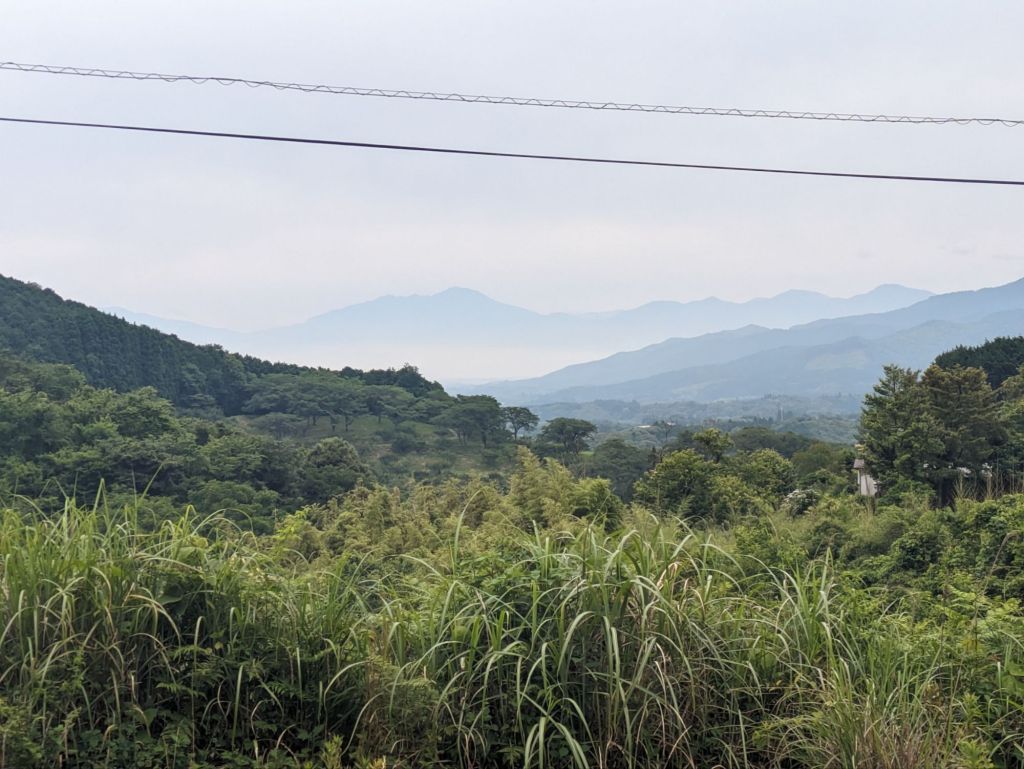
I passed a farm where I peered into a barn. A bull with a bright red ring through its nose came to see who was staring at him. I passed the solar farm and a sign which read, “Road ahead closed.” Nothing like giving you, say, 20k warning. I’d climbed 800 metres. There was no way I was cycling back. I came across a group of maybe 15 men – helmets, hi vis, facemasks, overalls – laying a short stretch of asphalt. They all looked at me, manoeuvred out the way, let me past. The last one said, “Hello.”
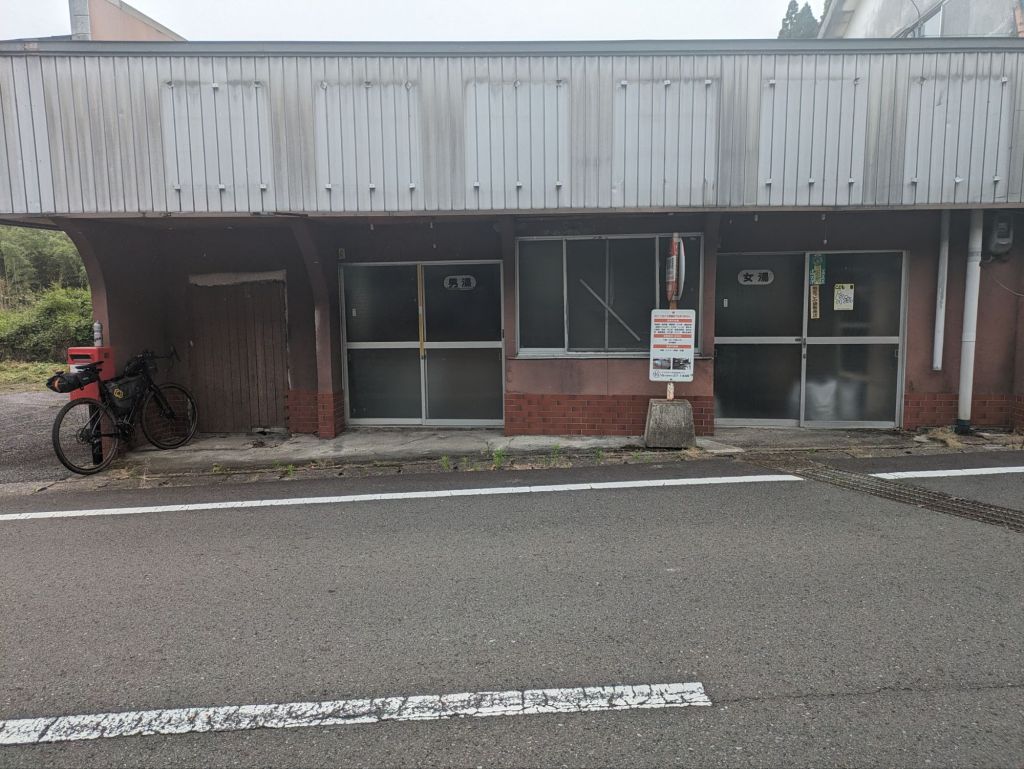
True to the lady’s word, drizzle began to fall. I propped Ribena against an abandoned onsen, drank half a Coke, and put on my rain jacket. My rain trousers and thermals were in the back of Julian’s car.
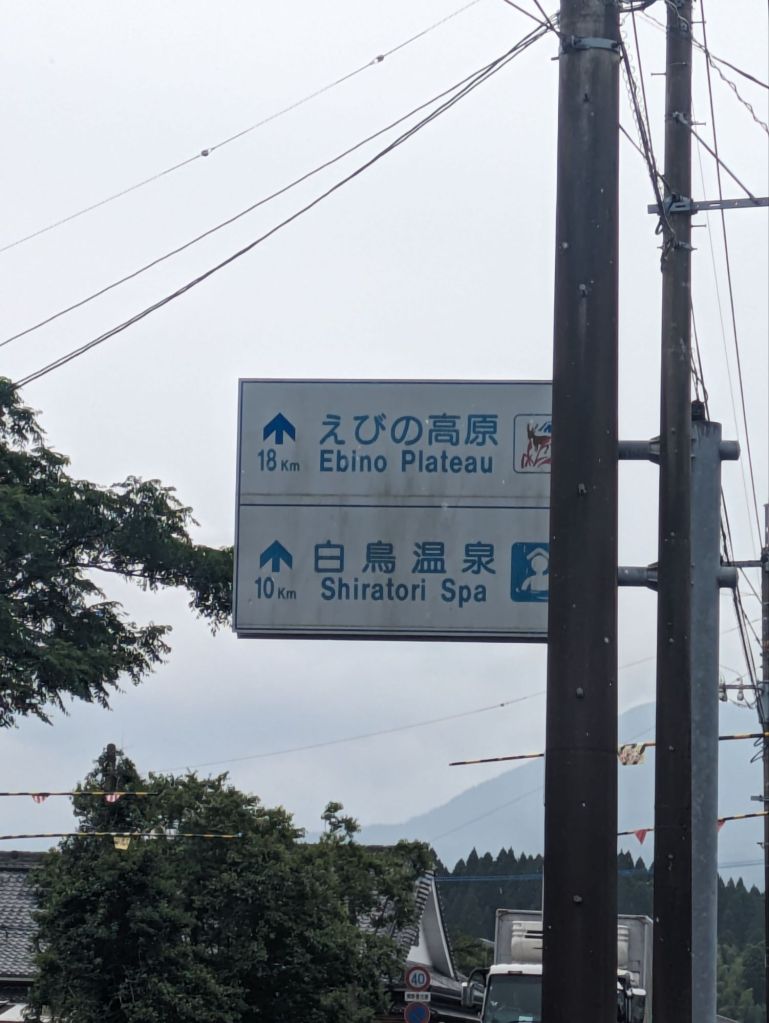
My route took me past the outskirts of Ebino. I got to the jumping off point for the 1000m climb up Kirishima Renzen, the Fog Island Mountains, and somehow I didn’t fancy it. The rain had picked up and wind along with it and I was feeling tired having stayed up to 2am finishing this blog. I toyed with the idea of finding a hotel, resting and doing it in the morning when the weather would be better. I wanted to find a large anonymous chain restaurant where I could weigh my options and instead went into a small ramen shop by the station.
A man sat at the counter watching me as I read from the menu, painted onto wooden panels hung above the bar.
“Wife, you have a customer.”
A woman appeared looking startled. I sat down and she poured me a cup of oolong cha.
“Fried vegetable ramen, please.”
Her husband appeared and eyed me suspiciously, saying nothing. Wrong shop, I thought.
I stood to go to the bathroom to wash my grubby hands. There was a step up so I asked the husband, “Would you like me to take my shoes off.”
He nodded that I should, which I did, and I followed the woman into what turned out to be their house to the toilet, a squatter with a hole that opened directly into a cess pit. I really had come to the wrong place.
I returned to the shop and watched the man fry the vegetables. He asked me where I was from. We began to chat and I realised he had just been confused, assuming I didn’t speak Japanese and unsure how to communicate. The food was delicious, the best ramen I’ve had so far with a rich broth and tasty toppings. The man sat at a chair and we continued chatting.
I’ve realised the best question to ask a Japanese person is where they were born. In Hokkaido everyone is an immigrant and they tell their immigrant stories. Like in so many other places in Honshu and Kyushu, the man said, “Right here,” and pointed at the floor.
“I worked in Tokyo for some years but came back.”
We talked about the countries we’ve visited and the things we had seen. When I told him I was a bookseller he told me he read the newspaper from cover to cover and novels for an hour everyday.
“But no one reads anymore and all the bookshops are closing. Is it the same in England?”
I nodded. “People just look at their phones.”
When I left the rain had stopped and with summer good conversation and food inside me I didn’t think twice about cycling up the mountain. Mood is food, just as Chris Perry commented.
My girlfriend won an award for a novel she had written. Called Fog Island Mountains (and with my apologies for the Amazon link. We sell the book in the shop too!) it’s set around Kirishima, where she worked for two years as an English teacher. I sent her this photo at the foot of the climb. She wrote back, “You’re in Kanai country now,” naming her female protagonist.
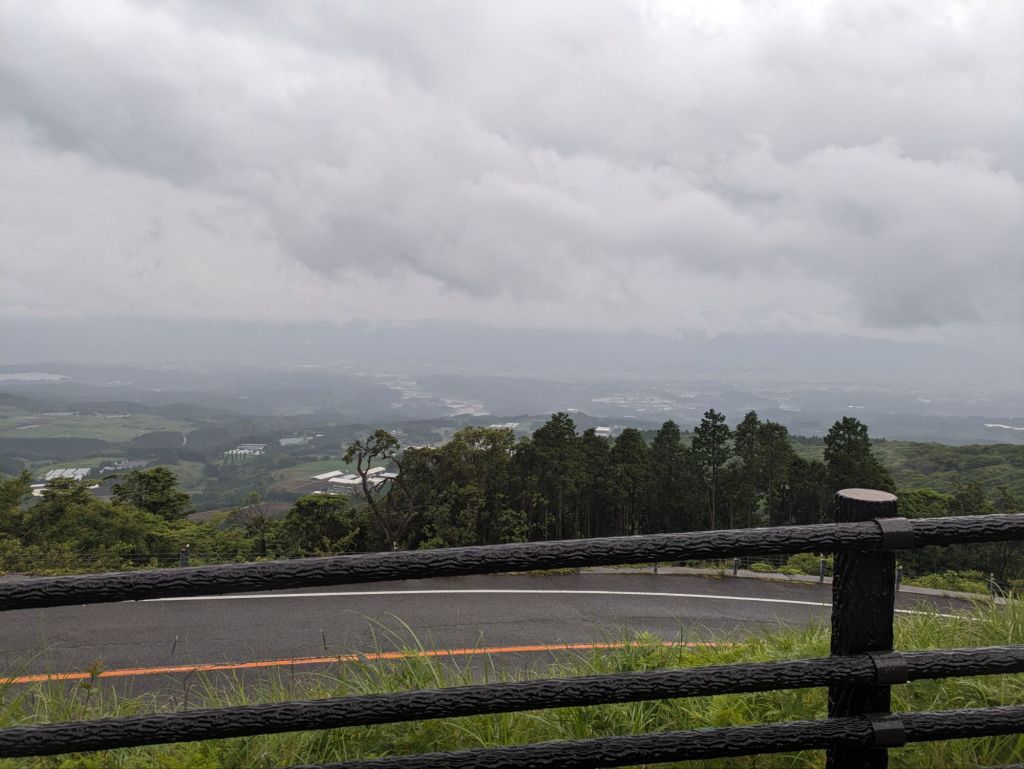
The climb was tough. In the very steep sections where the gradient was over 10%, I had to put a foot down and rest. But I didn’t give up. Towards the top, the mountain exhaled clouds of steam in great whistling breaths. The smell of sulphur hung in the air
The drizzle turned to rain and the temperature dropped in increments. I began to shiver despite the exertion. I knew the beginning would be hard, the middle section slightly easier, and the last three kilometres were classed as easy. Overall the climb was classed as HC, hors categorie, in the French system. I dreamed of a light climbing bike carrying just a water bottle. I dreamed of being thirty years younger.
I made it to the top and went into the first hotel I came to.
“I don’t have a reservation but I would love to use a vending machine if you have one.”
I sat in the warm, the rain in my clothes soaking into a fancy armchair and worked out the route to my hotel. 13 kilometres, mainly downhill. I could do that, once I warmed up.
I rode Ribena as aggressively as I could in the wet, and she loved it. She’s an Amazonian, built to win long distance races across gravel, and she soaked up the bumps and responded when I stood out the saddle and pumped up the climbs. We did those last kilometres in a little over twenty minutes.
My hotel reminds me of luxury buses from the 1970’s, checked industrial carpet, doilies and brass knobs you twist to turn the lights on and off. It’s run by a Chinese lady who spoke Chinese into Google Translate when she had a question or needed to explain something. She grabbed towels and dried Ribena.
There is a bath house, not pretty, but with water straight from the volcano. I’m lying in a dressing gown and my skin smells like sulphur. The lady showed me how to turn the sign to show that the bath was occupied, which I dutifully did, even though I am the only guest here and the hallways are silent.
I called my Kendo teacher in Himedo Machi and felt less lonely. We are meeting next week. I promised him I would come and we never break our promises.
I rode 75km today and climbed 2000m. It’s time to sleep.




Leave a comment